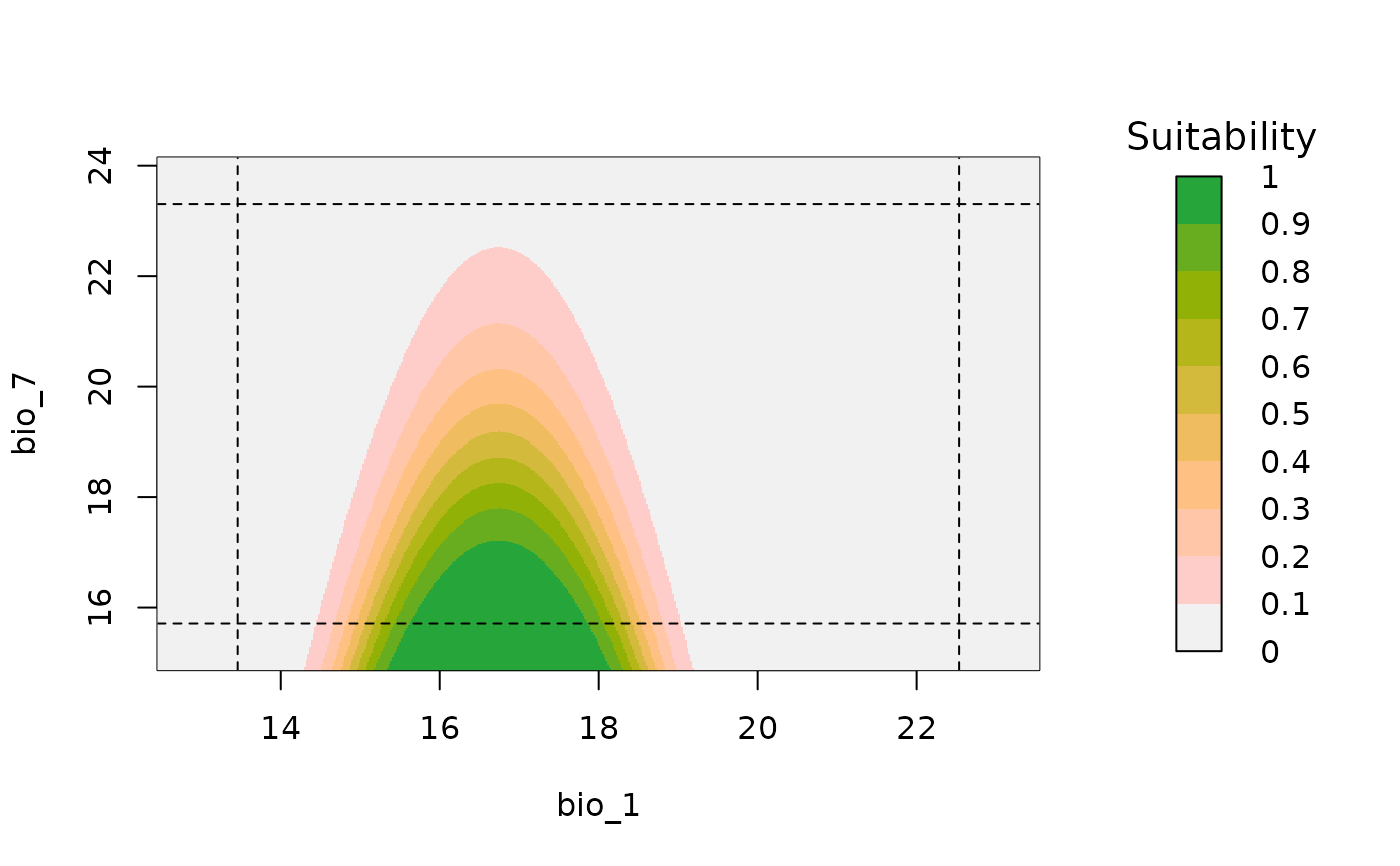
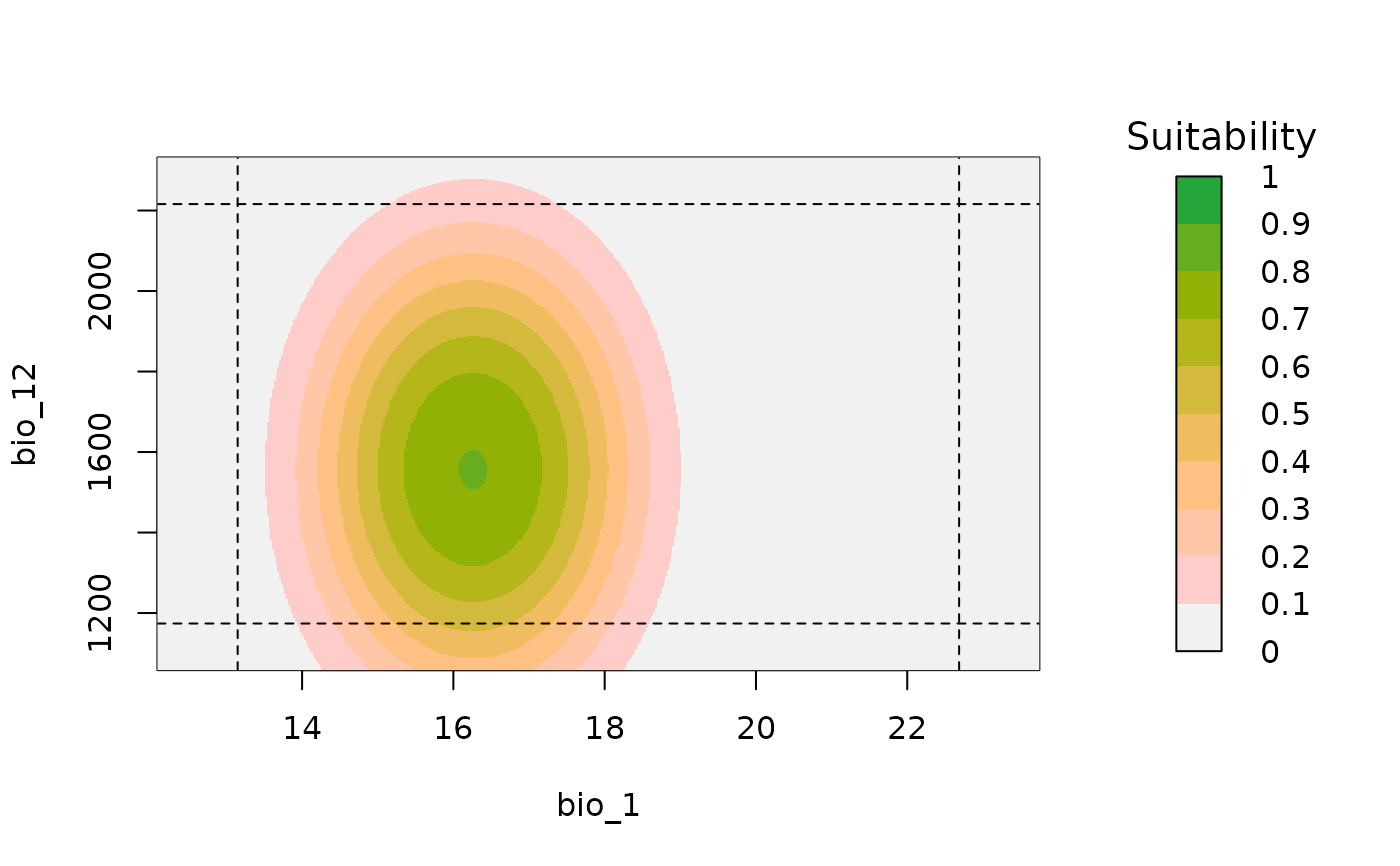
A plot of suitability in a two-dimensional environmental space to show the prediction response based on two variables.
Usage
bivariate_response(models, variable1 , variable2, modelID = NULL,
                   n = 500, new_data = NULL, extrapolate = TRUE,
                   extrapolation_factor = 0.1, add_bar = TRUE ,
                   add_limits = TRUE, colors = NULL, breaks = 10,
                   xlab = NULL, ylab = NULL, ...)
Arguments
- models
an object of class
fitted_modelsreturned by thefit_selected()function.- variable1
(character) name of the variable to be plotted in x axis.
- variable2
(character) name of the variable to be plotted in y axis.
- modelID
(character) name of the ModelID presents in the fitted object. Default = NULL.
- n
(numeric) the number of breaks for plotting grid. Default = 500.
- new_data
a
SpatRaster, data.frame, or matrix of variables representing conditions of interest to check responses. Default = NULL.- extrapolate
(logical) whether to allow extrapolation to study the behavior of the response outside the calibration limits. Ignored if
new_datais defined. Default = TRUE.- extrapolation_factor
(numeric) a value used to calculate how much to expand the training region for extrapolation. Larger values produce extrapolation farther from training limits. Default = 0.1.
- add_bar
(logical) whether to add bar legend. Default = TRUE.
- add_limits
(logical) whether to add calibration limits if
extrapolate = TRUEornew_datais defined. Default = TRUE.- colors
a set of colors for values of suitability above the threshold from omission error. The default, NULL uses
hcl.colors(breaks, "Blue-Yellow").- breaks
(numeric) integer number to define number of color breaks to use, if
colorsis not defined. Default = 10.- xlab
(character) a label for the x axis. The default, NULL, uses the name defined in
variable1.- ylab
(character) a label for the y axis. The default, NULL, uses the name defined in
variable2.- ...
additional arguments passed to
image.
Examples
# Example with glmnet
# Import example of fitted_models (output of fit_selected())
data(fitted_model_maxnet, package = "kuenm2")
# Response curve (notice response affected by covariance)
bivariate_response(models = fitted_model_maxnet, modelID = "Model_219",
variable1 = "bio_1", variable2 = "bio_12")
 # Example with glm
# Import example of fitted_models (output of fit_selected())
data(fitted_model_glm, package = "kuenm2")
# Response curve
bivariate_response(models = fitted_model_glm, modelID = "Model_85",
variable1 = "bio_1", variable2 = "bio_7")